






FAQs
8/1/2026
Contents
Products
Residential Lawns









Explore
Where to Buy


To eliminate wild violets, hand-pull young, isolated plants or treat established patches with a selective triclopyr herbicide. Check the label against your grass type, since cool- and warm-season lawns tolerate different products. Apply treatments in fall, when violets move energy into rhizomes. Then improve turf density through proper mowing, watering, fertilizing, and reseeding to prevent bare spots and regrowth later.
You notice a few purple flowers along the edge of your lawn, but weeks later the same area has turned into a stubborn patch of wild violets. Many homeowners try pulling them out or spraying once, only to see new leaves return. These weeds are common, but removing them takes the right timing and method. This guide explains how to identify wild violets, choose the right control approach, treat established patches, and improve your lawn so they are less likely to come back.

How Do You Identify Wild Violets in a Lawn?
Before you start treating wild violets, make sure you are actually looking at the right weed. This section explains the key features to check, including leaf shape, flower color, growth habit, and how to tell wild violets apart from similar lawn weeds like ground ivy.
Flowers are the clearest sign in spring. Most are purple to blue-violet, though white and pale forms also appear. Each flower has five petals and sits close to the foliage rather than standing well above the lawn. After bloom, the plant remains as a green patch that blends into turf unless you check the leaf shape. Wild violets grow low in clumps with heart-shaped leaves, often on individual stems. The leaves can look slightly glossy or waxy, which is why spray droplets often bead up instead of spreading. The edges are usually gently toothed, not deeply lobed.
Do not confuse wild violets with ground ivy. Ground ivy has rounder, scalloped leaves, a mint-like smell when crushed, and creeping square stems that root at the nodes. Wild violets form tighter crowns and spread by rhizomes and seed. Get that wrong and you waste time on weak control.
This quick comparison helps you avoid treating the wrong weed.
Feature | Wild Violet | Ground Ivy |
|---|---|---|
Leaf shape | Heart-shaped, gently toothed, often waxy | Rounder leaves with scalloped edges |
Stem habit | Tight crowns from rhizomes | Creeping square stems that root at nodes |
Smell when crushed | No strong mint smell | Mint-like smell |
Spread pattern | Rhizomes plus seed | Creeping surface stems plus seed |
Why Are Wild Violets Hard to Control?
Wild violets are difficult to eliminate because removing the visible leaves does not remove the whole plant. Their thick underground rhizomes store energy and produce new shoots after mowing, pulling, or an incomplete herbicide treatment. Even a small section left in the soil can support regrowth.
Their waxy leaves also limit how much spray enters the plant. Light coverage, application during drought, or treatment when growth is slow may damage the foliage without reaching the crown and roots. This is why one application rarely controls an established patch.
Wild violets can also spread in more than one way. Rhizomes gradually enlarge the existing colony, while both visible flowers and small flowers near the soil produce seed. New plants may therefore appear beyond the original patch.
Control becomes harder in shaded or compacted areas where lawn grass is thin. Successful removal usually requires repeat treatment, monitoring for new shoots, and improved turf density over more than one growing season.
How Do You Get Rid of Wild Violets Step by Step?
Wild violet control should match the size of the infestation and the condition of the lawn. Small plants can often be removed manually, while established colonies need targeted treatment followed by turf repair.
Step 1: Choose a Method for the Situation
A few young plants: Dig them out when the soil is moist and loose.
An established patch: Use a selective broadleaf herbicide labeled for wild violets and your grass species.
A thin lawn with widespread violets: Treat the weeds first, then repair bare areas during the appropriate seeding season.
Flower beds or renovation areas: Remove the crowns and connecting rhizomes while the soil can be disturbed freely.
Step 2: Remove Small Plants Completely
Loosen the soil around each plant with a narrow weeding tool and lift the crown, roots, and fleshy rhizomes together. Pulling only the leaves allows stored underground tissue to produce new shoots. Recheck the area after several weeks and remove any regrowth while it is still small.
Step 3: Treat Established Patches Carefully
Select a lawn-safe post-emergent herbicide that specifically lists wild violet. Products containing triclopyr are often more effective on established colonies than standard three-way mixtures. Before application, confirm the permitted turf species, rate, weather limits, and retreatment interval on the label.
Apply while the violets are actively growing and the lawn is not drought-stressed. Late-summer or fall treatment is commonly effective because perennial weeds are directing energy toward their underground structures. Wet the leaves evenly without allowing spray to run off, and use a surfactant only when the product label permits it.
Step 4: Repeat and Monitor
Inspect the patch after the waiting period stated on the label. Twisted, yellowing, or stalled leaves indicate a response, though surviving crowns may produce fresh growth. Apply the next treatment only at the labeled interval; established wild violets commonly require repeated control across more than one growing season.
Step 5: Help the Lawn Fill the Open Space
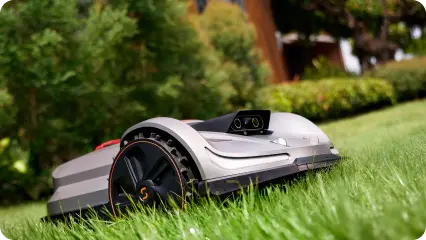
Once the treated area is ready for normal use, maintain a consistent mowing height so surrounding grass can thicken without being scalped. The Sunseeker Elite X5, a robotic lawn mower, supports this stage with adjustable cutting height and app-based scheduling for regular light cuts. Align its mowing schedule with the herbicide’s stated reentry and mowing intervals.
Remove remaining crowns, level any divots, and reseed thin areas with grass suited to the site. Denser turf reduces the open ground available for new violet seedlings and slows the expansion of surviving patches.

How Can You Prevent Wild Violets From Coming Back?
Wild violets are less likely to return when the lawn remains dense and the conditions that favored them are corrected. Focus on closing bare soil, reducing turf stress, and checking previously affected areas before new plants establish.
Wild violets are easier to manage when you focus on the whole lawn, not just the visible leaves. The most reliable approach is to identify the weed correctly, use a grass-safe treatment at the right growth stage, and repair the conditions that allowed the patch to spread.
For small patches, careful removal may be enough. Larger or older infestations usually need repeat treatment, follow-up inspection, and stronger turf density. Once the lawn is back under control, steady mowing, proper watering, and filling bare spots give violets fewer chances to return.
Wild violets can spread into thin or shaded turf and gradually occupy space where grass is already weak. They spread through seeds, creeping roots, and rhizomes, forming dense patches over time. They rarely overwhelm a thick, healthy lawn quickly, so improving mowing height, fertility, drainage, and grass density helps slow further invasion.
Yes. Wild violets are difficult to control because their waxy leaves resist sprays and their fleshy rhizomes store enough energy to regrow after mowing or incomplete removal. Digging can work for small patches if every root and rhizome is removed. Established infestations often require repeated treatment over more than one growing season.
Use a selective broadleaf lawn herbicide containing triclopyr; it is generally one of the most effective active ingredients for wild violets. Confirm that the label lists both your grass species and wild violet. Treat actively growing plants, preferably in late summer or fall, and repeat only at the labeled interval. Avoid nonselective glyphosate on turf.