







FAQs
7/16/2026
Contents
Products
Residential Lawns






Explore
Where to Buy


Measuring lawn square footage doesn’t have to be complicated. You can calculate your yard size by using basic formulas for rectangles, triangles, and circles, or use online tools that measure your property through satellite images. This guide shows you simple ways to get accurate results and use them for better lawn care.
If you are planning to seed, fertilize, or lay sod, the first thing you need to know is your lawn’s size. Without that number, it’s easy to buy too much or too little, and that can lead to wasted money and uneven growth. So, how to measure lawn square footage? It’s not that complicated. In this comprehensive guide, we will introduce step-by-step instructions. You can also find online tools for faster estimates and how to apply your results to real lawn care tasks easily!
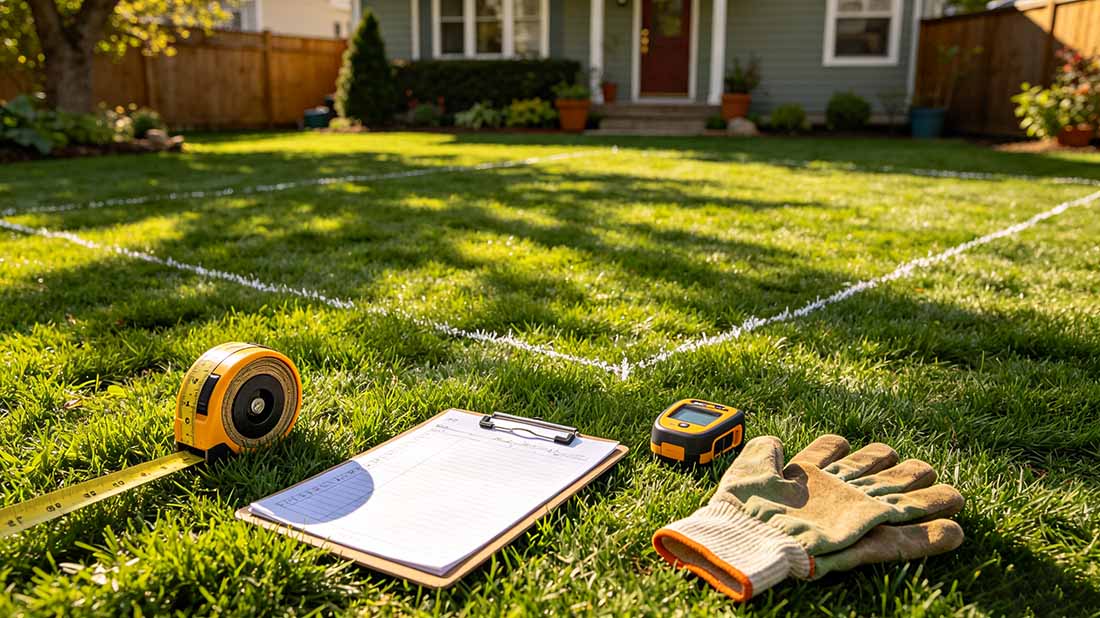
Lawn measurement might seem like a small step, but it’s actually the foundation of effective lawn care. Without your exact square footage, it’s difficult to plan or apply treatments correctly. Here are the main reasons why measuring your lawn size matters:
As you can see, measuring lawn square footage is essential for many aspects of lawn care. Now, let’s see how to measure square footage of a lawn based on different shapes.
Square and rectangular lawns are the most common and the easiest to measure. This method works well for most standard yards that have straight, even edges.
Step 1. Measure the length of the area in feet.
Step 2. Measure the width of the area in feet.
Step 3. Multiply the two numbers: Length × Width = Square Footage
Example: A lawn that is 60 ft long and 35 ft wide equals: 60 × 35 = 2,100 sq ft
Triangular sections often appear in corners, sloped areas, or lawns with angled boundaries. Here’s how to measure square feet of a lawn in this shape.
Step 1. Measure the base (one straight side) in feet.
Step 2. Measure the height, which is the perpendicular distance from the base to the opposite point.
Step 3. Apply the formula: (Base × Height) ÷ 2
Example: A triangle with a base of 40 ft and a height of 25 ft equals: (40 × 25) ÷ 2 = 500 sq ft
Circular and irregular areas are common garden beds, curved edges, or rounded lawns. These require a slightly different approach but are still easy to calculate when broken down properly.
For circles: Measure the radius (distance from the center to the edge) in feet. Use the formula: π × r² (with π ≈ 3.14).
For irregular shapes: Divide the area into smaller shapes (rectangles, triangles, circles), calculate each, and add them together.
Example:
Today, online tools provide fast, visual estimates of lawn size using satellite imagery. For instance, Measure My Lawn, SuperSod Yard Calculator, and similar Google Maps-based apps can make the process effortless. Here’s how to measure lawn square footage with Measure My Lawn step by step.
Go to MeasureMyLawn.com or a similar tool, allow location access or manually enter your address, then wait briefly until your correct property loads before beginning measurement.
Switch to satellite or map view to clearly display your property, then zoom in carefully and adjust positioning so all lawn edges and grassy areas are fully visible.
Use the drawing tool to click around your lawn perimeter, outlining only grass sections. For this calculation, what counts as lawn is the planted turf area, so exclude the house, driveway, patios, sidewalks, garden beds, and other non-grass surfaces before saving the measurement.
Check the completed outline for accuracy and adjust boundary points if needed. Then view the calculated square footage, and save, screenshot, or record the results for future lawn care planning.
Once you know your total square footage, you can apply it to purchasing and maintenance. Here are tips for seed, sod, and fertilizer:
Seed: Follow the package rate, which is often 5 to 10 pounds(2.27 to 4.54 kg) per 1,000 square feet for new lawns. For a 4,000 square foot lawn, calculate the total seed needed and purchase slightly extra for overseeding.
Quick Math: 4,000 sq ft × 7 lbs ÷ 1,000 = 28 lbs(12.7 kg) of seed.
Sod: Order sod based on your exact lawn square footage, then add 5 to 10 percent to cover trimming, fitting edges, and small gaps, ensuring a complete and seamless lawn installation.
Quick Math: 2,000 sq ft + 10% = 2,200 sq ft of sod required.
Fertilizer: Apply fertilizer with recommended rates, usually 0.5 to 1 pound (0.23 to 0.45 kg) of nitrogen per 1,000 square feet. Divide the desired nitrogen amount by the fertilizer’s percentage to determine the correct total product needed.
Quick Math: 4,000 sq ft needs 2 lbs of nitrogen; with 20% fertilizer, 2 ÷ 0.20 = 10 lbs(4.54 kg) product.
Knowing your lawn size is also a huge help when it comes to mowing, but modern technology has made the process much easier. For instance, robot lawn mowers without perimeter wires can automatically map your yard and create efficient mowing routes without complicated setup. Unlike older models that rely on buried boundary cables, these models use advanced technology to understand your property’s exact layout and dimensions.
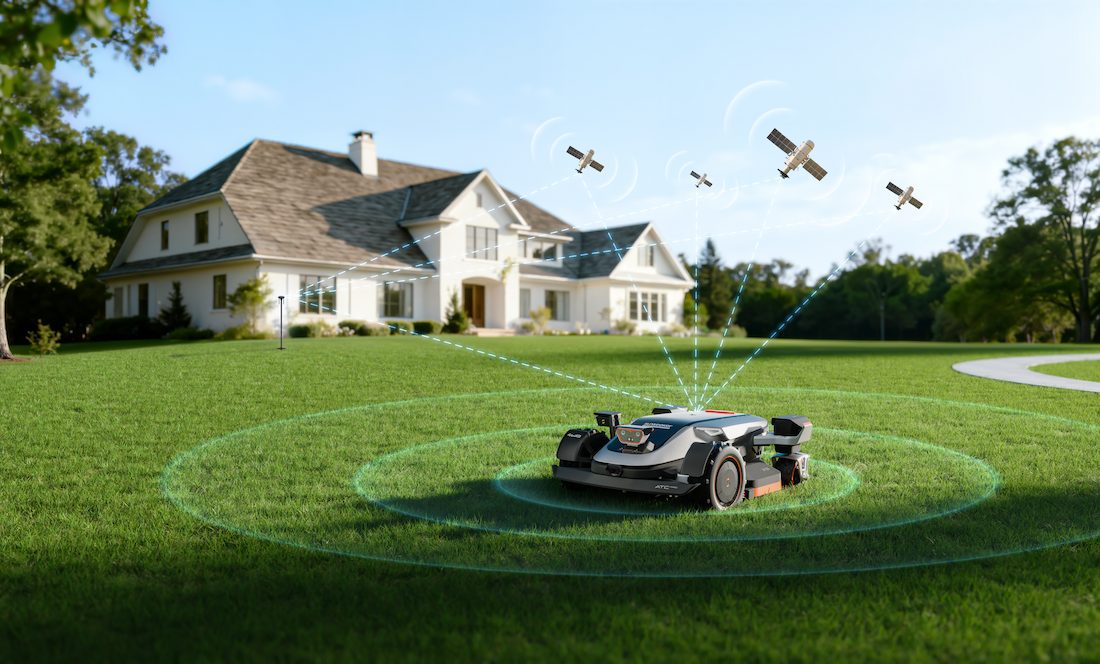
The Sunseeker Elite X9 is a high-performance solution in this regard. Designed for large-scale lawn care, it can maintain areas up to 24,000 square meters (6 acres) in 48 hours. With the intelligent navigation (AONavi™ 2.0) and RTK satellite positioning, it automatically maps your property’s size and boundaries, creating efficient mowing paths based on your lawn’s unique shape and dimensions. Combined with an all-wheel-drive system capable of handling slopes up to 90% / 42° and advanced sensors for obstacle avoidance, the X9 delivers precise, reliable mowing performance across large and complex landscapes.
How to measure lawn square footage? You can use manual methods to calculate based on shapes. Alternatively, online satellite tools can provide quick estimates in just a few minutes. Accurate lawn measurements are the foundation of effective lawn care, and robot lawn mowers take it a step further. Sunseeker’s smart solutions can automatically map your lawn and create efficient mowing paths without boundary wires. Explore the Sunseeker Elite X9 to simplify lawn maintenance with intelligent mowing and hands-free care from now on!
A 5,000 square foot lawn is considered a medium-sized yard, roughly equivalent to a square plot measuring about 71 ft on each side. This size is common in suburban backyards and provides enough room for family activities, patios, garden beds, and play areas while remaining manageable to maintain. With a standard push mower, mowing usually takes around 30–60 minutes.
A 1,000 square foot lawn is a relatively small yard, comparable to a 20 ft × 50 ft rectangle or a compact urban outdoor space. It is common for townhomes, starter homes, and smaller properties to offer enough room for seating areas, landscaping, or light outdoor activities. Maintenance is quick, often taking less than 15–20 minutes to mow with a standard push mower.
One-quarter acre equals 10,890 square feet. If shaped as a perfect square, each side would measure approximately 104 ft. This is a common suburban lot size that can accommodate a home, driveway, garage, and a spacious lawn with room for gardens, trees, and recreational areas. Compared with smaller yards, it provides more outdoor space while remaining practical to maintain.