
























Why Your Lawn Is Not Staying Green
A lawn loses its green color for predictable reasons, and most cases are not about “lack of effort” but about one or two broken fundamentals affecting how grass produces chlorophyll and holds moisture.
Watering issues
Inconsistent or shallow watering is the primary reason lawns fade from deep green to dull green or yellow. When water only reaches the surface, roots stay shallow, making grass highly sensitive to heat and drying. In summer conditions, this leads to rapid color loss even if the lawn looks fine after rain.
Mowing stress
Cutting grass too short or using dull blades reduces the plant’s ability to produce energy. Short blades mean less surface area for photosynthesis, while torn tips from dull mowing equipment turn brown quickly. This creates a faded or uneven green appearance even when the lawn is properly watered.
Nutrient imbalance
Grass color depends heavily on nitrogen availability and nutrient uptake efficiency. When nutrients are either insufficient or poorly absorbed due to soil conditions, grass turns pale green rather than deep green. Excess fertilizer can also create weak, unstable color that fades quickly under heat.
Soil compaction
Compacted soil restricts oxygen flow and blocks water and nutrients from reaching the root zone. This reduces root activity, which directly weakens chlorophyll production. The result is thin, dull-colored grass that struggles to recover even after watering or feeding.
Heat stress
Extended exposure to high temperatures slows down grass metabolism. During peak summer heat in many US regions, grass naturally shifts from deep green to a lighter, stressed tone as it prioritizes survival over growth.
How to Keep Your Lawn Green
To keep your lawn green, focus on the basics that build strong roots: healthy soil, deep watering, proper mowing height, steady nutrition, and quick attention to weeds, or bare spots. The routine itself is simple; the key is staying consistent and adjusting for conditions.
Fix watering pattern (deep vs shallow)
Shift from light daily watering to deep irrigation that reaches the root zone. In most US lawns, this means applying about 25 - 38 mm of water per week, split into 1–2 deep watering sessions rather than daily sprinkling.
Shallow watering keeps roots in the topsoil, where heat and evaporation quickly stress the grass, leading to a faded or yellow-green appearance. Deep watering encourages roots to grow downward, which stabilizes moisture uptake and restores a more consistent green tone during warm weather.
Correct mowing height
Mowing height directly affects how much energy the grass can produce. For most cool-season grasses, the optimal height is typically:
- Kentucky bluegrass / fescue: 76–102 mm
- Perennial ryegrass: 64–89 mm
For warm-season grasses, the range is usually:
- Bermuda: 25–51 mm
- Zoysia: 38–64 mm
Cutting below these ranges reduces leaf surface area, limiting photosynthesis and resulting in a lighter, less saturated green color. Consistently mowing within the correct range improves color depth and reduces heat stress on the soil surface.
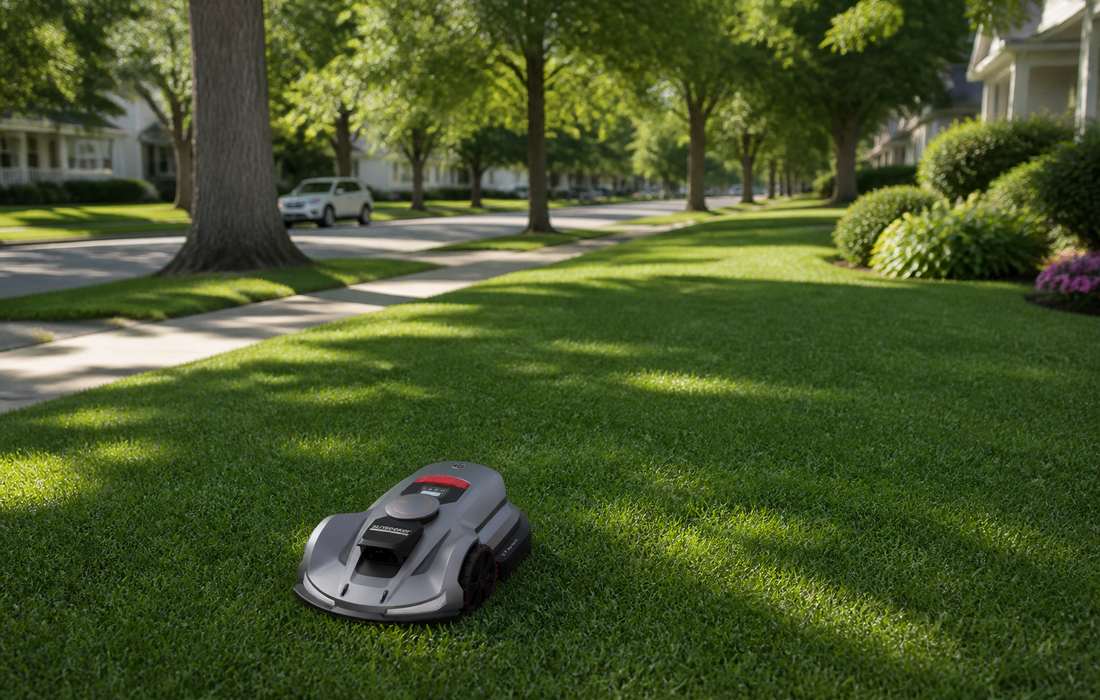
For homeowners who struggle to maintain this consistency during peak growing seasons, some automated systems such as the Sunseeker Elite X4 can help stabilize mowing frequency, supporting more uniform grass height without the stress spikes caused by irregular manual mowing.